I expected helping my grandmother choose an anniversary ring to be a joyful little mission. Instead, a saleswoman took one look at her worn cardigan, walking shoes, and old leather purse and decided she did not belong in the store. Within minutes, Grandma Margaret—who had survived a year of brutal cancer treatment—was standing beside a glass display with tears in her eyes. The employee had no idea who my grandmother was, what she had done for the store’s owner years earlier, or why the woman stepping out of the back office was about to make her regret every cruel word.
The day before, Grandma’s living room table had been covered with crumpled bills, coins, and several envelopes marked “Rings” in her careful handwriting. She counted everything twice, occasionally losing her place and blaming what she jokingly called “chemo brain.” Behind her sat the old sewing machine she had used for decades to alter clothes for neighbors and loyal customers.
Grandma and Grandpa Harry were approaching their fiftieth wedding anniversary. A year earlier, neither of them knew whether they would live to see it. Grandpa received a cancer diagnosis first. Six months later, Grandma was diagnosed too. Treatment took their hair, strength, appetites, and nearly forty pounds from each of them.
It also cost them the wedding rings they had worn for almost half a century. Grandma’s slipped from her thin finger while she washed dishes and disappeared down the sink. Grandpa then admitted his ring had vanished during a hospital visit weeks earlier. Neither was ever recovered.
After Grandpa finished treatment, Grandma decided they deserved a new beginning. She wanted two simple matching gold bands that fit their thinner fingers. For months, she quietly saved money from sewing jobs, birthday cards, and loose change. She refused to tell Grandpa because she wanted to surprise him at their anniversary dinner.
The next morning, I drove her to the nicest jewelry store in town. As we sat in the parking lot, Grandma held her purse tightly and repeatedly asked whether I had brought the money envelope. She admitted she was nervous. I promised to stay beside her.
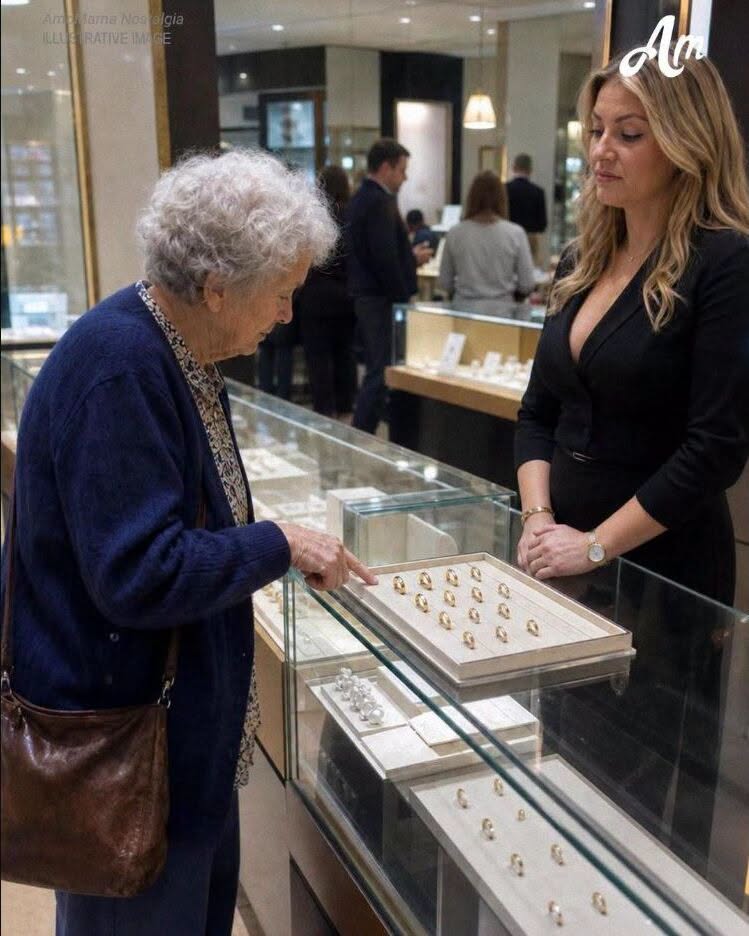
A bell rang as we entered. A young saleswoman named Chloe looked Grandma up and down. Her polite smile disappeared almost immediately. Grandma did not notice. She went straight to a display of classic gold bands and politely asked to try one on.
Chloe did not unlock the case. She folded her arms and said the rings were not meant for casual browsing. She spoke loudly enough for nearby customers to hear.
Grandma softly explained that she only wanted to see whether the ring fit. Chloe laughed and told her that customers normally established a budget before handling the store’s premium collection.
I tried to explain that Grandma intended to buy two rings, but Chloe interrupted me. She said she did not want to hand expensive jewelry to someone who “obviously” was not there to make a purchase.
The entire store seemed to go silent. Grandma lowered her hand from the display. This woman had endured chemotherapy without surrendering, yet one stranger’s contempt reduced her to tears. She touched my elbow and asked me to take her home.
I wanted to challenge Chloe, but Grandma looked too hurt to remain there. We turned toward the exit. My hand had almost reached the door when a warm voice called Grandma’s name.
An elegant woman carrying coffee and a set of keys emerged from the back hallway. Her face brightened when she recognized Grandma. Chloe, meanwhile, froze behind the counter.
The woman was Donna, the store’s owner.
Donna hurried across the showroom and hugged Grandma for several seconds. She asked why Grandma looked so thin and why she was standing near the exit. Grandma tried to dismiss the situation, but Donna noticed her red eyes and my anger.
I told her exactly what had happened.
Donna’s expression changed. She called Chloe over. The saleswoman addressed her as “Aunt Donna” and attempted to defend herself by mentioning store policy. Donna immediately said there was no policy allowing an employee to humiliate a customer.
When Chloe insisted she had been protecting the inventory because Grandma did not “look like” a buyer, Donna asked her to finish the sentence. Chloe could not.
Donna then revealed the history Chloe had never bothered to learn. Years earlier, when Chloe’s cousin suffered a torn dress shortly before a rehearsal dinner, Grandma had crossed town in heavy rain, repaired it by hand, and refused payment.
That was not all. Two decades earlier, after Donna’s husband died, the jewelry store had nearly collapsed under debt. Donna had committed to preparing clothing for an important benefit event but could not afford the required alteration work. Grandma spent three weeks at her sewing machine adjusting dozens of gowns and tuxedos at cost. Whenever Donna tried to pay her, Grandma refused and told her to return the kindness someday.
Donna looked at her niece and said the same woman whose generosity helped save the business had just been told she was not good enough to touch a gold band.
Chloe whispered that she had not known.
Donna replied that this was precisely the problem. A customer should not need an impressive history, expensive clothes, or a personal connection to the owner to receive basic respect. She ordered Chloe to remain quiet and watch how every person entering the store should be treated.
Grandma, still compassionate despite what had happened, tried to excuse the young woman and suggested returning another day. Donna refused. She told Grandma that if she left without choosing a ring, Donna would drive to her house and put one on her finger herself.
For the first time since entering the store, Grandma laughed.
Donna escorted us to a beautifully lit display, unlocked it herself, and placed a velvet tray of classic bands before Grandma. She encouraged her to try every one. Several felt too loose or too heavy, but eventually one settled perfectly onto her finger.
Grandma chose it and requested a matching band for Grandpa. When I began counting her carefully saved bills and coins, Donna closed my hand. The rings were a gift, she said, and she would engrave both with their names and anniversary date.
The following evening, our family gathered around the anniversary table. Grandma slid the new ring onto Grandpa’s finger, and his eyes filled with tears. Then he surprised everyone by pulling a velvet box from his jacket. He had secretly been saving too.
Inside was a delicate gold band for Grandma. It fit as though it had always belonged there.
Watching them press their foreheads together, I understood that the most valuable thing connected to that jewelry store had never been locked behind glass. It was the kindness Grandma had offered decades earlier without expecting anything in return. That kindness had waited quietly until the exact moment she needed someone to return it.