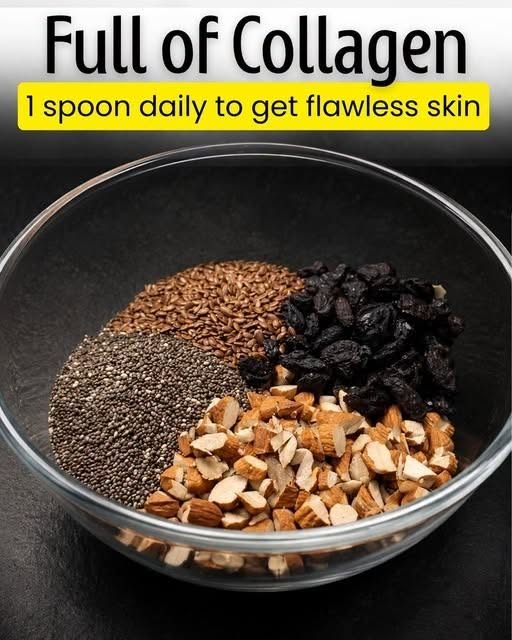
You cannot eat collagen and have it turn into collagen in your face. Whatever you swallow gets broken down into amino acids in your gut, and your body decides where those go. Collagen supplements sold in jars work on the same principle, which is why the ones with actual evidence behind them are hydrolysed peptides at fairly specific doses, and even then the effect is modest.
What you can do is make sure your body has everything it needs to build collagen. That process has hard requirements — vitamin C, copper, zinc, and the right amino acids — and if any of them is short, synthesis slows down. This powder is aimed at that. It’s food, not medicine, and its job is to remove nutritional bottlenecks rather than deliver collagen to your skin.
If your diet is already good, the difference will be small. If you’ve been eating badly, it will be more noticeable, and probably not just in your skin.
Why these ingredients
Vitamin C isn’t optional in collagen synthesis. The enzymes that stabilise the collagen triple helix need it as a cofactor, and this is why scurvy causes skin and gums to fall apart — the body keeps making collagen but can’t hold it together. Amla is one of the densest sources you can buy in India, and it holds its vitamin C better than most fruits because of the tannins in it.
That said, some of the vitamin C does degrade during drying. Buy amla powder in small quantities, keep it sealed and dark, and replace it every couple of months. A two-year-old packet at the back of a cupboard is mostly fibre.
Almonds bring protein and vitamin E. Collagen is unusually high in glycine, proline and lysine, and you need dietary protein to supply them. Vitamin E is fat-soluble and works alongside vitamin C in the skin’s antioxidant system.
Flax seeds are for the omega-3s and the lignans. There’s reasonable evidence that omega-3 intake supports skin barrier function and hydration. But flax only works ground — whole seeds pass straight through you undigested, which is a waste of good seeds.
Sesame and pumpkin seeds are the ones people leave out, and they shouldn’t. Lysyl oxidase, the enzyme that cross-links collagen fibres and gives them tensile strength, is copper-dependent. Sesame is a good copper source. Pumpkin seeds bring zinc, which matters for wound healing and skin repair.
Black raisins add iron and polyphenols, and they make the powder taste like something you’ll actually keep eating. Iron absorbs much better in the presence of vitamin C, so the amla and the raisins work well together in one spoon.
What you need
Makes roughly 400g, about a month’s worth.
Almonds — 1 cup
Flax seeds — ½ cup
White sesame seeds — ¼ cup
Pumpkin seeds — ¼ cup
Black raisins — ½ cup
Amla powder — 4 tbsp
Cinnamon powder — 1 tsp
Cardamom powder — ½ tsp
Walnuts work in place of some of the almonds if you have them. Everything else is worth keeping.
Making it
Dry roast the almonds on low heat for six or seven minutes, until they smell nutty. Don’t let them brown. Set aside to cool completely.
Roast the sesame and pumpkin seeds separately, two to three minutes, until the sesame starts popping. Then the flax, on very low heat for two minutes only. Flax has delicate oils and high heat damages exactly the thing you’re eating it for.
The raisins are the fiddly part. They’re sticky, and if you grind them with everything else you get a paste rather than a powder. Spread them on a plate and leave them under a fan for a few hours until they’re leathery instead of soft, or give them thirty seconds in a low oven. Then chop them roughly before they go in.
Cool everything fully. Warm ingredients release oil in the grinder and you’ll end up with a clump.
Grind the almonds and seeds together in short pulses. Long continuous grinding heats the mixture and turns it into nut butter. Add the chopped raisins and pulse a few more times. Then stir in the amla, cinnamon and cardamom by hand — no heat, no grinding, so the vitamin C stays intact.
How to use it
One tablespoon a day. Morning is easiest.
Stir it into warm milk, mix it into curd, add it to a smoothie, or eat it plain off the spoon with water. Don’t add it to anything boiling — heat destroys vitamin C, which is the point of the amla.
Store it in an airtight glass jar in the fridge and finish it within three or four weeks. Ground flax goes rancid quickly at room temperature, and rancid oils are worse for you than no oils. If it smells sharp or paint-like, it’s gone.