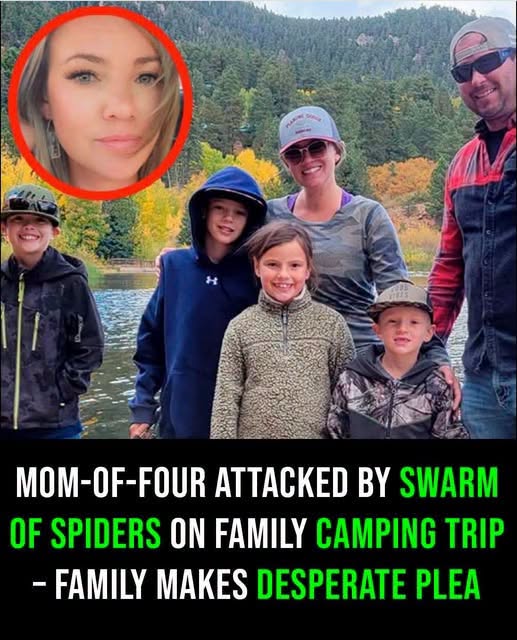
What was supposed to be a blissful weekend escape for Britagne Miller and her family at Cheney State Park transformed into a heart-stopping, visceral nightmare that pushed her to the very brink of death. While sitting innocently by a campfire, she was viciously swarmed by spiders, an attack that sparked a catastrophic chain reaction inside her body. Within days, her life was hanging by a thread as doctors issued the most devastating prognosis imaginable: prepare for the end. Locked in a brutal war against her own failing organs, this mother of four faced a fight for survival that would shatter any human spirit.
The tragedy began on May 28, a date that will forever be etched into the memory of the Miller family. Britagne, a devoted mother from Goddard, Kansas, was enjoying the warmth of the fire with her husband, Jake, and their four children. The peaceful atmosphere was shattered in seconds when she felt the crawling sensation of multiple spiders moving up her leg and body. She felt the sharp prick of bites across her skin, but like most of us, she brushed them off as a minor inconvenience of the great outdoors. She had no way of knowing that a potent cocktail of venom had just begun to circulate through her veins, initiating a systemic crisis that would push her body to its absolute limits.
For four days, the damage simmered beneath the surface. Then, the horror truly began. The bite on her calf erupted in a dramatic, terrifying display of swelling. A searing, stabbing pain, sharp enough to drop a grown person to their knees, shot violently down her leg and into her foot. By June 4, the situation had become untenable, and she was rushed to Wesley Hospital in Wichita. The initial assessment was grim. Doctors immediately identified a massive hematoma and rushed her into emergency surgery. They extracted nearly 300ml of dark, stagnant blood clots from her mangled calf, inserting a drain in a desperate attempt to stabilize the tissue and stop the spread of whatever was ravaging her limb.
The road to recovery, which should have been a straightforward path of healing, quickly veered into a life-threatening crisis. Britagne was fighting a war on two fronts: the spider venom and a collection of pre-existing health complications that had been lying dormant. During a previous pregnancy, she had been diagnosed with two complex blood-clotting disorders. Compounded by pre-existing liver damage and a laundry list of severe allergies to common foods and medications, her body simply lacked the resources to mount a successful defense. In the days that followed the surgery, she frequently became incoherent, her mind drifting into the fog of trauma.
The medical team watched in horror as her condition deteriorated into what they feared was end-stage liver failure. After two weeks of intensive care, the specialists delivered the news that no family should ever have to hear: they recommended hospice care. “They gave me three days up to a month to live, so that was scary,” Britagne later revealed in an interview with local media. She was trapped in a cycle of suffering, spending ten grueling days in the Medical Intensive Care Unit and further time in the cardiac ICU before finally being stable enough to be transferred to a standard ward. She became a prisoner of her own treatment, receiving a constant stream of blood transfusions, plasma, platelets, and aggressive antibiotics, all in a desperate bid to coax her organs back into operation.
Just as the family began to hope for a reprieve, a second crisis struck. Five days into her tenuous recovery, the surgical wound became infected with a dual threat of staph and a gram-negative infection. The tissue began to die—a process known as necrosis—forcing surgeons to perform two emergency bedside procedures. Britagne was pushed to the psychological edge; she later admitted to reaching a point where she was ready to simply give up. It was only the haunting, desperate image of her four children that forced her to keep fighting when every part of her wanted to succumb to the exhaustion.
The financial toll of the tragedy has been as devastating as the physical one. While Britagne fought for her life, her husband, Jake, remained a steadfast guardian at her bedside, juggling his duties as a single father to their four children. His employer eventually terminated him, citing his inability to meet work schedule expectations during the crisis. The loss of his income and their health insurance has left the family in a precarious position, struggling to manage the crushing weight of ongoing medical costs, specialist visits, and the basic necessities of life. Britagne’s mother traveled all the way from Utah to step into the role of primary caregiver for the children, while the family has turned to the generosity of strangers via a GoFundMe page to keep their heads above water.
While her recovery is ongoing, Britagne faces a long, uncertain road ahead. She is expected to return home eventually, but she will require constant, high-level home health care and intensive physiotherapy. Her dreams of a swift return to normalcy are tempered by the reality that she is not yet eligible for a liver transplant; her blood-clotting conditions must be brought into a state of total stability before such a major operation can even be considered—a process that doctors estimate could take months of meticulous, painful care.
While the exact species of the spiders that attacked her remains unconfirmed, entomological experts point toward the brown recluse as the most likely culprit. Alongside the black widow, it remains one of the two venomous arachnids that pose a genuine threat in Kansas. The brown recluse is notorious for its preference for dark, hidden spaces—under logs, in damp rock piles, and inside unused shoes or boxes left in garages. It bites only when it feels trapped against human skin. Dr. Raymold Cloyd, a horticultural entomologist at Kansas State University, warns that this tragedy serves as a harrowing reminder for all who enjoy the outdoors. Whether you are camping in the wild or simply moving boxes in a dusty attic, he advises wearing heavy gloves and, most importantly, shaking out every pair of shoes before sliding your feet inside.
For a healthy adult, a brown recluse bite is often a painful but manageable ordeal, but for Britagne Miller, it served as a catalyst for a perfect storm of medical complications. Her story stands as a visceral warning of how fragile the line between a family holiday and a total life collapse truly is.