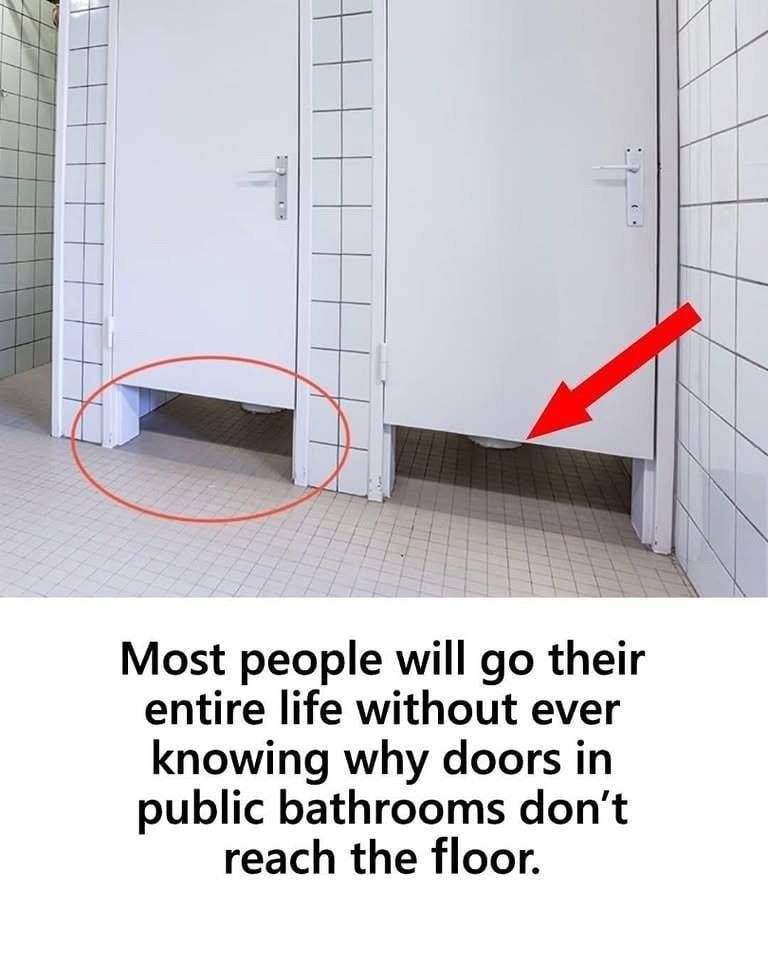
Why Public Bathroom Doors Don’t Reach the Floor: The Real Reasons Behind the Design
Many people have wondered why stalls in public bathrooms often have large gaps beneath the doors and walls. Although the design may feel uncomfortable or lacking in privacy, architects, engineers, and public facility planners explain that these gaps exist for several practical, economic, and safety reasons.
Public restroom design is heavily influenced by:
Safety regulations
Maintenance needs
Ventilation
Cost efficiency
Emergency accessibility
The familiar stall structure seen in shopping centers, airports, schools, and restaurants became widespread because it solves several operational problems at once.
1. Faster Emergency Access
One of the main reasons for the floor gap is safety.
If someone inside a stall:
Faints
Has a medical emergency
Becomes unconscious
Needs urgent help
staff or emergency responders can more easily see the situation and access the stall quickly.
In locked floor-to-ceiling compartments, emergency intervention becomes much more difficult and time-consuming.
Building safety experts explain that public spaces must prioritize rapid accessibility during emergencies.
2. Easier Cleaning and Maintenance
Public bathrooms experience extremely heavy daily use, especially in:
Airports
Schools
Restaurants
Stadiums
Shopping centers
Floor gaps allow janitorial staff to clean floors more efficiently using:
Mops
Pressure cleaning
Cleaning machines
Without fully enclosed walls touching the ground, dirt and moisture are easier to remove.
This design also helps reduce:
Water accumulation
Mold growth
Odor retention
3. Improved Air Circulation
Ventilation is another major factor.
Public restrooms naturally accumulate:
Humidity
Odors
Bacteria-containing aerosols
Open gaps help air circulate more freely throughout the restroom, allowing ventilation systems to work more effectively.
Better airflow may help:
Reduce unpleasant odors
Decrease moisture buildup
Improve overall hygiene conditions
Completely enclosed stalls would trap heat, humidity, and odors more intensely.
4. Lower Construction Costs
Floor-to-ceiling stalls require:
More material
More hardware
Stronger structural support
More labor
Traditional partially open stalls are significantly cheaper and faster to install.
For large public facilities containing dozens or hundreds of stalls, these savings become substantial.
Economists and architects often balance:
Cost
Durability
Safety
Maintenance efficiency
when designing commercial restrooms.
5. Reduced Misuse and Vandalism
Public facility planners also note that visible gaps may discourage certain inappropriate activities inside stalls.
Partially open designs can help reduce:
Vandalism
Smoking
Drug use
Unsafe behavior
Excessive occupancy times
Because complete isolation is reduced, public spaces become easier to supervise indirectly.
Why Some Countries Use Different Designs
Bathroom stall designs vary greatly worldwide.
In some countries, public toilets provide:
Nearly full privacy
Floor-to-ceiling partitions
Completely enclosed cabins
These systems are more common in:
Luxury facilities
Airports
Modern office buildings
Some European and Asian countries
Cultural expectations regarding privacy often influence restroom architecture.
The Psychological Discomfort Many People Feel
Psychologists explain that many individuals experience stress or discomfort in partially open restroom stalls because humans naturally seek privacy during vulnerable moments.
Research suggests lack of privacy may increase:
Social anxiety
Embarrassment
Restroom avoidance behavior
Some people even delay using public bathrooms because of discomfort related to exposure or fear of being observed.
Could Public Bathroom Design Change in the Future?
Modern architects increasingly explore designs that balance:
Privacy
Hygiene
Accessibility
Cost efficiency
Newer restroom concepts sometimes include:
Better acoustic insulation
Smaller gaps
Occupancy indicators
Improved ventilation systems
However, completely enclosed stalls remain more expensive and harder to maintain in high-traffic environments.
Scientific Conclusion
The gaps beneath public bathroom doors are not random design flaws. They exist primarily for safety, ventilation, maintenance efficiency, emergency access, and cost reduction.
Although many people dislike the reduced privacy, architects and public facility planners continue using this design because it offers practical advantages in heavily used public spaces. Future restroom designs may gradually improve privacy while still preserving hygiene and safety requirements.