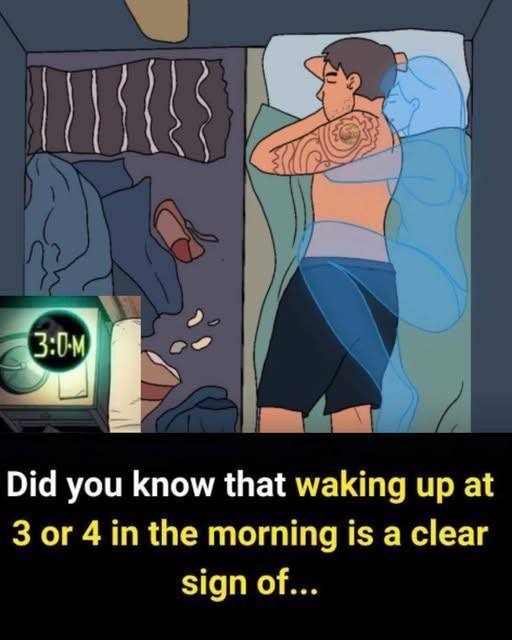
It starts the same way for millions of people.
You’re deep in sleep, dreaming perhaps, or just drifting in the void. Then—snap. Your eyes open. The room is pitch black. The house is silent. You check your phone: 3:17 AM.
There was no loud noise. No sudden shock. No urgent need to use the bathroom. Just a quiet, abrupt return to consciousness.
You roll over, pull the pillow over your head, and pray for sleep to return. But it doesn’t. Instead, your mind begins to race. Thoughts you successfully ignored during the busy daylight hours suddenly demand your attention. Did I send that email? What if I lose my job? Why did I say that thing five years ago?
If this sounds familiar, take a deep breath. You are not broken. You are not alone. And contrary to popular belief, waking up at this specific window isn’t always a sign of insomnia or physical illness.
Often, it’s a clear sign of unprocessed emotional load.
It’s Not Always the Body That Wakes You
We tend to look for physical culprits first. Was I hungry? Was the room too hot? Did I drink too much water?
While these factors play a role, for many chronic “3 AM wakers,” the body is actually asleep. It’s the mind that clocks in early.
During the day, we are masters of distraction. We have meetings, social media, chores, conversations, and noise. We keep our brains so occupied that there’s no room for deeper, heavier thoughts to surface. We push them down, telling ourselves, “I’ll deal with that later.”
But at 3 AM, there is no “later.” There are no distractions. There is only silence. And in that silence, the things you’ve been postponing finally have the microphone.
The “Quiet Hour” of Unprocessed Emotions
Psychologists and sleep experts often refer to this phenomenon as the “Anxiety Window.”
Between 3:00 and 4:00 AM, your cortisol levels (the stress hormone) naturally begin to rise in preparation for waking up. For most people, this happens gradually while they’re still asleep. But if you are carrying a high baseline of stress, anxiety, or unresolved grief, that cortisol spike can be enough to jolt you awake.
Once you’re awake, your prefrontal cortex—the logical part of your brain—is still groggy. But your amygdala—the emotional center responsible for fear and threat detection—is wide awake and hyperactive.
This creates a perfect storm:
High Emotional Sensitivity: You feel worries more intensely than you would at noon.
Low Logical Reasoning: You lack the mental clarity to rationalize those worries.
Isolation: The darkness and silence make problems feel insurmountable because you can’t take immediate action.
You aren’t just waking up; you’re waking up into a state of heightened emotional vulnerability.
Why the Mind Chooses This Moment
There is something psychologically significant about these hours. The world feels paused. The sense of isolation becomes sharpened.
At 3 AM, you cannot fix things. You can’t call your boss. You can’t have a difficult conversation with your partner. You can’t solve the financial problem. You can only think about them.
And so, the mind loops.
It revisits past decisions with harsh judgment.
It catastrophizes future outcomes.
It asks questions that have no immediate answers.
This doesn’t mean something is “wrong” with you. It means your mind is attempting to process what has not yet been resolved. It’s trying to clear the cache, but it’s doing it at the worst possible time.
The Difference Between Awareness and Fear
It’s important to distinguish between awareness and fear.
Awareness is noticing a thought: “I am worried about this project.”
Fear is attaching a story to it: “I’m worried about this project, which means I’m going to fail, which means I’ll lose my house, which means I’m a failure.”
At 3 AM, we almost always default to fear. The lack of context makes everything feel bigger than it is. Recognizing this distinction is the first step to breaking the cycle.
What Can You Do About It?
You don’t have to accept 3 AM as your daily therapy session. Here are three gentle strategies to help you reclaim your rest.
1. The “Brain Dump” Before Bed
Since your mind wakes up because it’s trying to process unresolved thoughts, give it a chance to do so before you sleep. Keep a notebook by your bed. Before you turn out the light, write down everything on your mind—tasks, worries, ideas. Tell your brain: “It’s written down. It’s safe. We can handle it tomorrow.”
2. Don’t Fight the Wakefulness
Paradoxically, trying hard to fall back asleep creates performance anxiety, which releases more cortisol, keeping you awake. If you’ve been awake for more than 20 minutes, get up. Go to a different room. Read a boring book. Listen to calm music. Do not look at your phone. Return to bed only when you feel sleepy again.
3. Practice “Non-Sleep Deep Rest” (NSDR)
If you’re stuck in bed, try a body scan meditation or a guided NSDR script (available freely online). This technique calms the nervous system and lowers cortisol. Even if you don’t fall back asleep, resting your body in this state is restorative.
When to See a Doctor
While occasional early waking is normal and often stress-related, chronic insomnia can impact your health. See a doctor if:
This happens 3+ nights a week for more than three months.
You feel exhausted during the day despite being in bed for 8 hours.
You suspect sleep apnea (snoring, gasping for air).
Anxiety or depression is interfering with your daily life.
The Bottom Line
Waking up at 3 or 4 AM is not a curse. It’s a signal.
It’s your mind’s way of saying, “Hey, we have some things we need to look at.” It’s uncomfortable, yes. But it’s also an invitation to slow down, to process, and to be kinder to yourself.
Tonight, if you wake up, don’t panic. Acknowledge the thought. Thank your mind for trying to help. And gently guide yourself back to rest. You don’t have to solve everything in the dark. The sun will rise, and with it, the clarity to handle whatever comes next.
Do you often find yourself waking up in the early hours? What’s the first thing that comes to mind when you do? Share your experiences in the comments below—sometimes, just knowing others are awake with us makes the night feel a little less lonely. 🌙