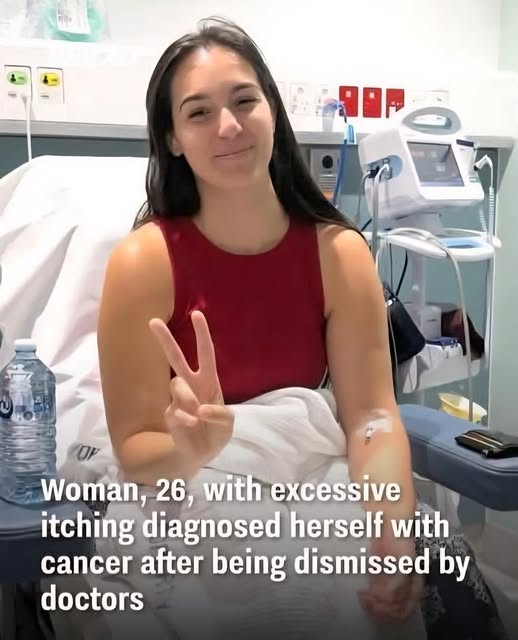
A young woman spent nearly a year dealing with persistent and uncomfortable symptoms before she was finally diagnosed with cancer. Sumbul Ari had been experiencing continuous itching for an extended period, and the condition progressively worsened until it severely disrupted her daily life. The itching became so intense that she was unable to sleep properly, often waking repeatedly during the night to scratch and relieve the irritation.
Since the symptoms first began in April last year, Sumbul made multiple visits to doctors in search of answers. However, despite her repeated efforts to seek medical help, she was turned away on several occasions.
At one point, a medical professional suggested that her itching was simply due to dry skin and advised her to apply moisturiser, while another reassured her by saying it was “just one of those things.”
As her condition progressed, Sumbul began experiencing a wider range of symptoms. These included changes in her body temperature, a loss of appetite and energy, and the development of a cough.
Sumbul’s symptoms persisted over time to the point where she described feeling “emotionally, mentally and physically exhausted.”

At this stage, the 26-year-old said she had already begun to suspect cancer after researching her symptoms online, which she referred to as going down a “Reddit rabbit hole” each night. She stated that after reading about combinations of symptoms such as itchy skin, night sweats, and fatigue, she became convinced something serious was wrong.
Her condition prompted further medical attention after she discovered a lump in her neck. Following this development, doctors began taking her concerns more seriously and subsequent examinations revealed abnormal and enlarged lymph nodes in other areas of her body.
Eventually, she was diagnosed with Stage 2-3 Hodgkin lymphoma in March 2026.
Hodgkin lymphoma is a type of cancer that affects the lymphatic system, which plays a role in the body’s immune system. Although no cancer is easy to cope with, it should be noted that Hodgkin lymphoma is generally regarded as one of the most treatable types of cancers. As of 2026, medical science has reached unprecedented heights of success in treating it.
With Hodgkin lymphoma, the normal function of B lymphocytes that help protect your body from infection becomes disrupted when they start to mutate and reproduce uncontrollably. The affected cells are known as Reed-Sternberg cells.
Instead of supporting your body’s immune response by assisting in fighting infection, the cells accumulate in your lymph nodes – small structures that resemble beans within your body. Lymph nodes form part of your lymphatic system that can be likened to the “highway system” of your immune system, which explains why the diaphragm is considered the Great Divide.
Speaking of her diagnosis, Sumbul said, “I didn’t care if it was cancer, I just wanted the itching to stop and wanted a full night’s sleep.
“Being told I had cancer was relieving. I finally had an answer. But I was very frustrated at all the doctors who dismissed me, and very, very angry.
She added: “There is nothing more frustrating than knowing there is something incredibly wrong, but being brushed off by the people who are supposed to help.”
At the time being, she’s receiving chemotherapy and says the unpleasant symptoms have since disappeared.
“I can’t believe I am saying this, but I sleep every single night like a baby, and I no longer scratch myself,” she said, adding: “Every single morning I wake up grateful for a full night’s sleep. I forgot what it felt like to wake up well rested.”
This young woman is urging everyone out there to listen to their body and seek answers whenever they feel like anything isn’t right. “Never stop advocating for yourself when you know something is deeply wrong. Keep trying until someone listens,” she says.
Many people with Stage 2 or 3 Hodgkin lymphoma experience what doctors call “B Symptoms”:
Drenching night sweats (needing to change pajamas or sheets).
Unexplained fevers.
Unintended weight loss.
A persistent, “itchy” feeling without a rash (Pruritus).